Most personality tests ask you to rate statements like "I am assertive" on a scale of one to five. It's fast, but it has a built-in flaw: it only measures how you see yourself, on that particular day. Story-based assessments take a different route — they watch what you actually choose. Here's why that matters.
The problem with rating yourself
Self-report questionnaires depend on you being an accurate, honest, and consistent judge of your own behavior. In reality:
- We answer how we'd like to be. Few people rate themselves as "impatient" or "disorganized," even when they are.
- Mood colors everything. The same person answers differently on a good day versus a stressful one.
- They're easy to game. Once you spot what a question is measuring, you can steer the result — consciously or not.
How a story-based assessment works
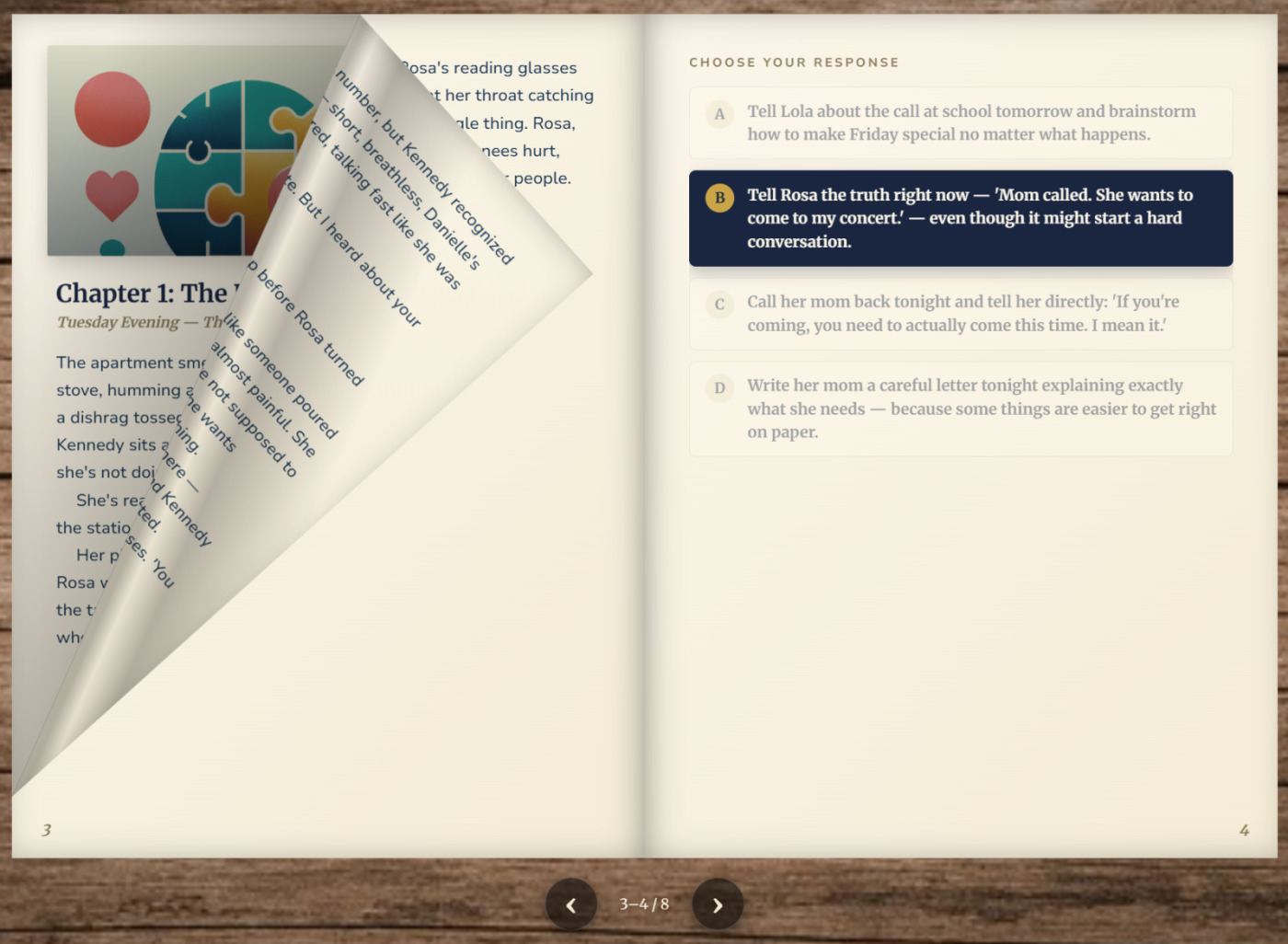
Instead of asking you to describe yourself, a DISC story assessment drops you into a scenario — a tense meeting, a family decision, a moment of pressure — and asks a simpler question: what do you do? Each choice quietly maps to a DISC trait. Make enough choices across a story, and a profile emerges from your actual decisions rather than your self-image.
Why choices reveal more than checkboxes
Behavior under realistic pressure is far harder to fake than a self-rating, because you're focused on the story, not the test. You're not thinking "what does this question want?" — you're thinking "what would I actually do here?" That's exactly the signal a personality assessment is trying to capture.
Especially powerful for kids
For children, the difference is night and day. Rating abstract statements is boring and confusing for a child; making choices in an adventure is neither. That's why a story-based approach works so well for kids — and why it doubles as a reason to keep reading.
Try one for yourself
Curious how the format works end to end? Here's the full explainer on story-based DISC assessments. Or just browse the assessment library and step into a story — your DISC profile builds itself as you read. It's the rare personality test that's genuinely enjoyable to take.